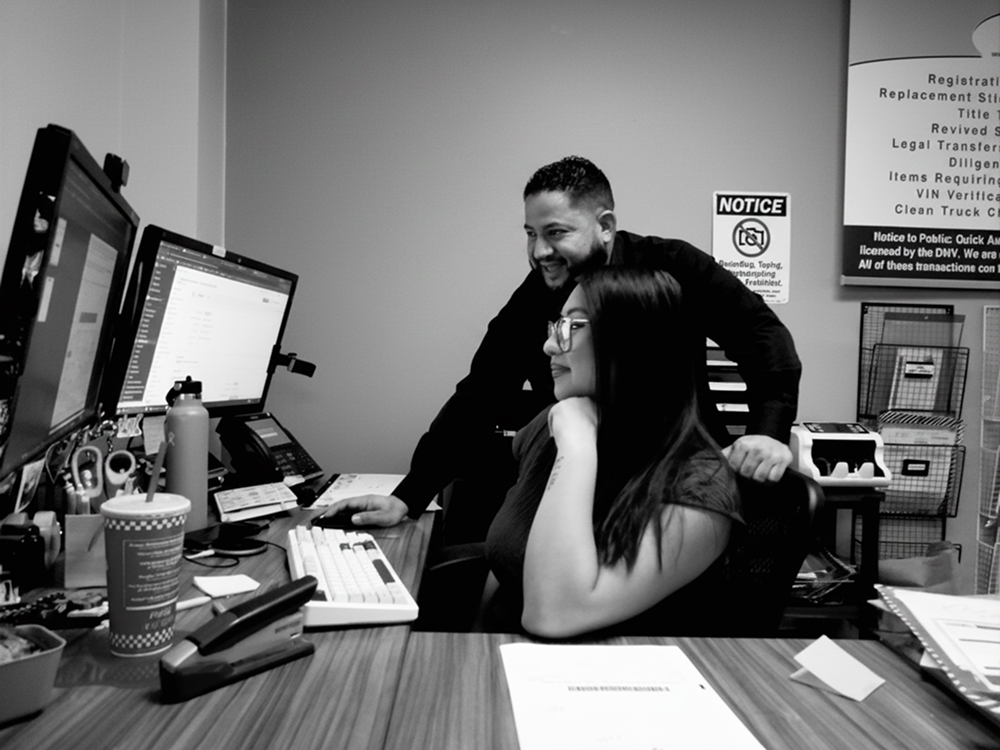
When Fleet Managers Spend More Time at the DMV Than Managing Their Fleet
Fleet managers are supposed to manage operations — vehicle uptime, maintenance coordination, driver logistics, compliance, scheduling, growth.
But for one Orange County fleet manager we’ll call “Jacki,” an increasing share of her week was disappearing into something else entirely: the DMV.
Jacki manages a fleet for a Southern California pest control company. She’s the kind of person who builds systems before she needs them. PFR account — set up and active. Spreadsheets — maintained weekly. Fleet management software — fully adopted. IBC appointments — booked proactively, never last-minute.
On paper, her compliance operation was tight.
In practice, it was eating her alive.
The Problem Wasn’t Organization — It Was the Process Itself
Anyone who has handled California fleet registration at scale already knows: even meticulous preparation doesn’t prevent friction.
Jacki found herself making repeat trips to the IBC for the same batch of vehicles — sometimes three or four visits over paperwork discrepancies that barely qualified as errors. A signature placement issue. A mismatch between a lienholder name on the title and the name in the PFR system. A fee calculation the system flagged even though the numbers were correct.
None of these were compliance failures. They were administrative friction — the kind that doesn’t trigger alarms but quietly consumes hours.
What a “Quick DMV Trip” Actually Costs a Fleet Manager
For a fleet manager, a trip to the IBC is never contained. It radiates outward across the rest of the day.
There’s the 30–45 minutes driving there. The wait, even with an appointment. The review, the correction, the re-review. Then the drive back — often with a pickup still pending for later in the week.
A single batch of registration work could absorb three to four hours of a workday. Multiply that across a fleet with rolling renewals, new acquisitions, and title corrections, and the math gets ugly fast.
Meanwhile, the rest of the fleet doesn’t pause. Drivers still call with problems. Vehicles still need to be coordinated. The schedule still needs to hold together. And the fleet manager — the person the company hired to keep all of that moving — is sitting in a DMV parking lot.
That’s the breaking point. Not a dramatic failure. Just the slow realization that administrative friction has become the dominant task.
Fleet Managers Shouldn’t Become Full-Time Registration Coordinators
Jacki’s role was supposed to be strategic and operational. She was hired to optimize a fleet, not shuttle paperwork between an office and a government counter.
But California fleet registration has a way of expanding to fill whatever capacity you give it — especially for operations already running lean. The more vehicles, the more renewals. The more renewals, the more IBC visits. The more visits, the more corrections. And before long, the person responsible for fleet performance is spending a third of her week managing paperwork logistics.
That’s when she reached out to Cali Fleet Pros.
What Changed
Within the first hour of onboarding — introductions, account setup, and a walkthrough of her pending work — we resolved two registration deals that had been bouncing between her desk and the IBC for weeks. One was a title correction that had required three separate visits. The other was a PFR submission that kept getting kicked back over a documentation technicality.
The next day, we completed ten additional transactions from her backlog.
As confidence built, Jacki started routing more of her DMV-related workload through our team — not just the stuck deals, but the routine renewals, the title transfers, the new registrations she used to handle herself.
Not because she couldn’t do the work. Because doing it herself was the wrong use of her time.
The Real Outcome Wasn’t Faster Processing
The paperwork moved faster, yes. But that wasn’t the transformation.
The transformation was that Jacki got her week back. The hours she used to spend driving to the IBC, waiting for reviews, and re-submitting corrected forms — those hours went back into the work that actually moves a fleet forward: vehicle coordination, operational oversight, driver support, compliance management, and scaling the business.
She stopped functioning as a registration coordinator and went back to being what the company actually hired her to be: a fleet manager.
The Growth Problem No One Talks About
Here’s what catches growing fleets off guard: registration and title work doesn’t scale linearly. It compounds.
More vehicles means more renewals, more deadlines, more CARB exposure, more title corrections, more administrative surface area. At a certain fleet size, handling it all internally stops being a discipline problem and becomes a math problem — there simply aren’t enough hours in the week, even for a team that’s doing everything right.
That’s the inflection point where the right support partner changes the equation. Not by doing the work faster, but by removing an entire category of operational drag so the people responsible for the fleet can focus on the fleet.
The Quiet Realization
Most fleet managers don’t fully register how much time and operational energy they’re losing to DMV-related work until they stop doing it themselves.
The difference tends to be immediate: less back-and-forth, fewer wasted hours, fewer interrupted days. More focus where it actually belongs — on the fleet itself.